
Read my advice about which combinations of sump pits, primary sump pumps and battery backups are needed for larger homes. Knowing how to upgrade your sump pump system is just as important as knowing why.
Most people don’t think about their sump pump until it fails. But if you own a larger home, the risk of water damage increases. More square footage usually means more ground to protect, more runoff to handle, and more expensive finishes to preserve.
If your current system feels overworked, it may be time to upgrade your sump pump system. Acting early helps avoid costly cleanup, mold, and long-term damage to your foundation or belongings.
Table of Contents
All Homes Need a Backup Sump Pump. Especially Larger Homes.
If one sump pump fails, hopefully, the second backup sump pump can handle the water flow. If not, then it is time to upgrade your sump pump to a larger horsepower.
Many backup sump pumps are 1/3 HP, even when the main sump pump is 1/2 HP. This usually works for most smaller homes until the backup battery is drained. Which could be in hours or days, depending on weather conditions.
To upgrade your sump pump system for a larger home, you would need two sump pits and two 1/3 HP primary pumps with 1/3 HP backup pumps as a minimum. That also means two backup batteries.
Both sump pits with sump pump basins could be side by side if need be. However, they should be place on opposite sides of a larger home.
Alternative Backup Sump Pumps for Larger Homes
Consider two sump pits, each with ½ HP primary sump pump and a 1/3 HP battery powered backup sump pump.
The during extreme weather events, the two 1/2HP sump pumps together would handle very large flows of water.
Even if both ½ HP sump pumps failed at the same time, the two 1/3 HP backup pumps could possibly handle any normal amount of water flow for a large home.
Another alternative is a 1/2 HP primary sump pump and a 1/2 HP battery backup sump pump shown below:
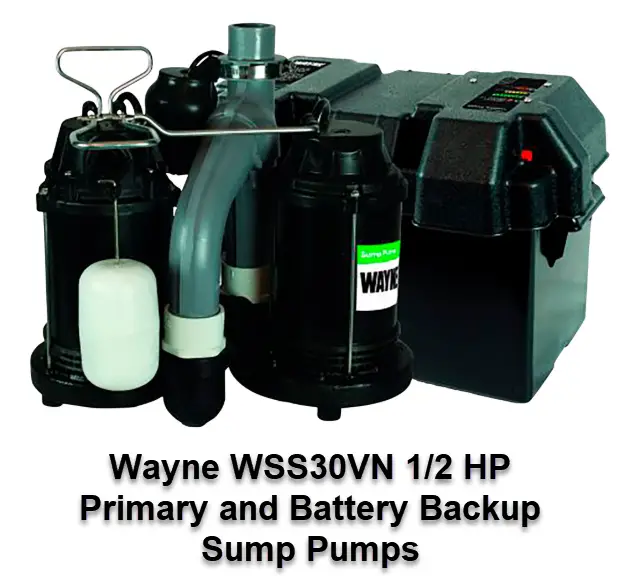
When using a 1/2 HP battery backup sump be sure to buy two 100 Amp Hour batteries to provide enough run time to protect your home.
Understand How Larger Homes Stress Sump Pump Systems
Increased square footage means more areas where water can collect. In larger homes, basements often include several rooms, extended hallways, or divided zones. A single sump pit may not be positioned to catch water from every corner. That increases the chance that water buildup will go unnoticed.
If these areas are used for long-term storage or are partially finished, the consequences become more severe. Furniture, boxes, or shelving units can block airflow and make leaks harder to detect.
Water often seeps under items, hiding damage until it spreads. In multi-room layouts, water can collect far from the pump’s reach.
Homes built with larger footprints often sit on more complex drainage paths. That means more gutters, downspouts, and perimeter grading—all of which can shift over time. A small shift in drainage can overload a system that once worked fine.
If your sump pump is rated for a smaller home, it may fail during a heavy storm or thaw. Under high demand, one pump can’t keep up, leading to water backups or motor burnout.
A failure in a central unit can cause widespread flooding before you even notice it’s not running. In larger homes, one small leak can affect multiple zones within hours.
When to Upgrade Your Sump Pump
If you have recently finished your basement, expanded usable square footage, or rethought how the lower level supports daily needs, your existing sump pump may no longer be adequate.
Changes to how the space is used often alter drainage demands, especially after adding patios, garden beds, or retaining walls that redirect water toward the foundation.
A decluttering project usually starts with a clear plan for the space. As you decide what the basement should store—or no longer store—you may discover moisture issues that were previously hidden behind boxes or shelving.
Purging stored items you no longer use exposes floors and walls, making it easier to spot slow drainage, damp corners, or signs that the pump struggles during heavy rain or snowmelt.
Cleaning the area thoroughly and checking for moisture should follow.
As zones shift from storage to active use, and as layouts become tighter with shelving or partitions, making the space more functional can reduce airflow and limit access for inspection, increasing reliance on consistent water control.
If water removal feels slower than expected or the pump cycles more often, an upgrade is frequently simpler and more cost-effective before damage occurs rather than after.

Signs Your Current Sump Pump Can’t Keep Up
Some signs are obvious, others subtle. If your pump cycles constantly—even when there’s no heavy rain—it’s working too hard. That usually means the motor is struggling or the inflow rate exceeds the discharge speed.
Damp corners, musty odors, or visible rust on metal components also signal problems. A good system should keep the entire space dry, not just the immediate area around the sump pit.
Older systems, especially those over ten years old, may not meet today’s needs. If you’ve renovated or added to your home, the original pump may be too small. Frequent tripping of the breaker or unexplained water spots are red flags.
Why Power and Capacity Matter in Pump Performance
Every sump pump has a horsepower rating and a gallons-per-hour limit. In larger homes, those numbers matter more. A system that works fine for a small basement might fail in a bigger one simply due to volume.
High-capacity pumps can move water faster during storms, snowmelt, or pipe failures. They also recover quicker, reducing the time water spends near your walls and floors.
Power isn’t just about speed. Larger basements might require dual-pump setups or battery backups to manage different zones. Installing the right model means fewer emergencies and less worry when you’re away.
Protecting Finished Basements and Valuables
Larger homes often have finished or semi-finished basements used for living, working, or storage. Water damage in these spaces costs more. Furniture, electronics, home offices, and gym equipment are hard to replace.
Drywall, flooring, and built-ins suffer from even minor moisture. Insurance may not cover gradual seepage or pump failure if your system wasn’t adequate for the space.
Many homeowners only realize the problem after the first major storm. By then, the cleanup costs exceed the price of an upgraded system. In homes with extensive finishes, upgrades should be preventative, not reactive.
How to Choose the Right Replacement or Upgrade
Start by reviewing the square footage and layout of your basement. Then consider water table levels and how quickly water pools during storms. A system that fits your design and local conditions performs better over time.
Work with a licensed plumber to assess pump size, location, and power needs. You may need a secondary backup unit, an alarm system, or battery support.
When you upgrade your sump pump system, particularly for larger homes, avoid over-relying on horsepower alone. Look for pumps that balance discharge rate, reliability, and coverage range.
Also, check how the discharge line is installed. Poor placement, too narrow or too wide pipes will reduce performance, no matter how powerful the motor is. Ensure the line is insulated in colder regions to prevent freezing.

Don’t Wait Until It Fails
Water damage rarely announces itself. Larger homes make it easier to miss warning signs until they become expensive.
Basements that look dry can still hold hidden risks, especially if your sump pump is aging or undersized.
If you’ve expanded, remodeled, or moved into a bigger space, it may be time to upgrade your sump pump system.
It’s a small investment compared to the cost of restoring flooring, furniture, and structure. Acting early protects both your property and your schedule from preventable disruption.
Best Sump Pumps for Every Budget: Which One is Right for You?